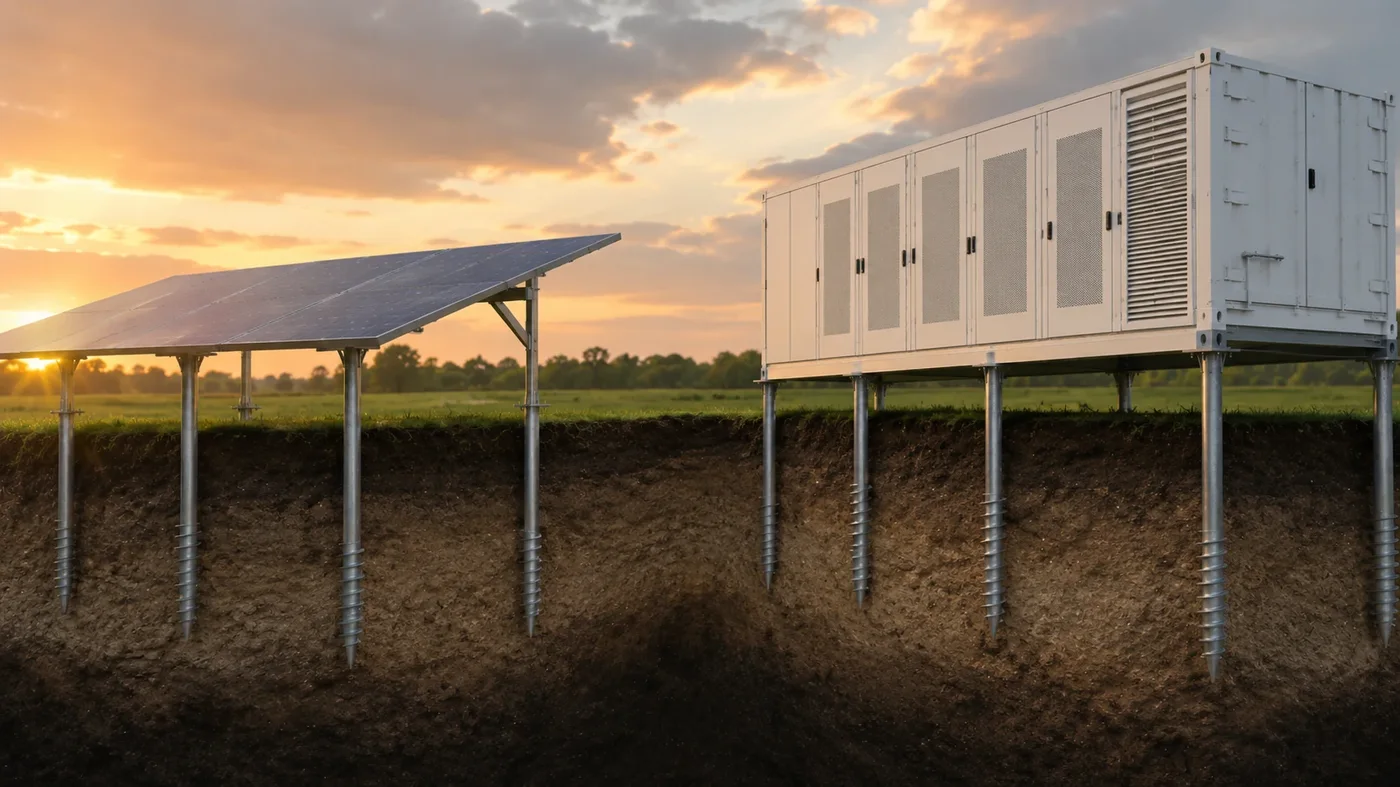
A solar park or a BESS system can seem simple from a foundation point of view: the equipment comes prefabricated, the positions are known and the site is usually open.
Problems appear when the surface ground is soft, uneven, wet or made of fill.
For a solar system, hundreds or thousands of points exposed to compression, uplift and wind must be stabilised.
For a BESS – Battery Energy Storage System – the situation is different: battery containers, PCS systems, transformers and auxiliary equipment can transmit significant loads to the foundation, and differential settlements must be controlled.
At such sites, steel screw foundations can be one of the most efficient solutions to analyse, because they allow the weak surface layer to be crossed and the loads to be transferred to a more suitable layer of ground at depth.
Without automatically having to excavate the entire platform and replace the soil.
For BESS and solar parks on soft ground, a screw foundation can have an important advantage when the weak surface layer can be crossed and there is, at depth, a layer in which the foundation can develop the required capacity.
By using longer screws or modular systems with extensions, we can adapt the depth of each point to the real conditions on site.
The solution can reduce:
- excavation
- massive replacement of soil
- the quantity of concrete
- the transport of materials
- execution time
- wet works
- intervention on the site.
But soft ground does not automatically mean that “screws surely work”.
The foundation must be designed, installed and verified for the specific equipment and site.
What is a BESS?
BESS stands for Battery Energy Storage System.
In commercial and industrial projects, a BESS can include:
- battery containers or cabinets
- PCS – Power Conversion System
- inverters
- transformers
- switchboards and medium-voltage equipment
- control systems
- cables and electrical routes
- access platforms
- fencing
- lighting and other auxiliary equipment.
BESS is increasingly used together with solar production for the controlled storage and delivery of energy; the US Department of Energy treats PV and BESS as systems that can be developed in an integrated way, and commercial BESS projects include not only the batteries but also the site works, the AC/DC networks and the auxiliary equipment.
For the foundation, this means we do not have a single type of load nor a single type of equipment.
Why is soft ground a problem for a BESS project?
The problem is not only whether the ground “holds the weight”.
Displacements must also be controlled.
A container can be heavy, but it can also be very rigid.
If one corner settles significantly more than the others, problems can appear with:
- the container frame
- doors
- connections
- cables
- routes
- auxiliary pipes
- alignment of the equipment
- the structures between modules.
In a BESS project with several units, differential settlements can become more important than the absolute settlement of a single point.
That is why, on soft ground, simply building a stone platform at the surface does not automatically solve the foundation of heavy equipment.
The solution: we pass through the weak layer, we don't necessarily try to build on it
This is one of the most interesting advantages of the screw foundation.
Let's suppose we have:
A shallow foundation may require:
With a screw foundation, the strategy can be different:
For this, depending on the project, longer one-piece products or modular systems with extensions can be used.
The advantage is that we don't necessarily have to turn the entire area of weak ground into a structural layer.
We intervene where the structure actually needs supports.
Why are modular systems interesting for BESS?
At a site with soft ground, the depth of the good layer can vary.
At one point we can meet it at 2.5 metres.
A few metres away it may appear at 3.5 metres.
In such situations, a modular system allows the foundation to be adapted through:
We do not assume, however, that every point must have the same length just so the bill of materials is simpler.
The ground does not respect the geometry of the project.
That is why, in a large energy park, the foundation must be thought through by geotechnical zones and verified on the ground.
What can the foundation of a BESS container look like?
There are several variants.
If the equipment is designed for point supports and the manufacturer clearly defines the positions and reactions, the screws can be positioned under these areas through heads or flanges designed for that connection.
It is a very interesting configuration when we want to distribute the loads.
The screws support a structure made of: HEA / IPE / specially designed profiles or beams, and the BESS equipment is placed over this platform.
The advantage is that the foundation and the equipment do not necessarily have to have the same grid. The steel structure distributes the loads to the foundation points.
In certain projects there may be a technical reason for the local use of concrete:
- the manufacturer's requirement
- a technical slab
- a transformer
- a basin or a retention area
- a special connection
- project requirements.
In this case, the screws can work together with a structure or a local concrete element.
We should not treat the problem as an ideological choice:
Sometimes the optimal solution is hybrid.
What information is needed from the BESS manufacturer?
Before designing the foundation we must have as clearly as possible:
- the dimensions of the equipment
- the total mass
- the permitted support positions
- the reactions at points, if available
- the centre of gravity
- the flatness requirements
- the permissible settlements
- the positions of the cables
- the lower routes
- the areas where the foundation cannot intersect the equipment
- the access and maintenance requirements.
Some commercial BESS systems are delivered in a highly integrated way, including with base elements and prepared cable routes, which makes coordinating the foundation with the exact geometry of the equipment all the more important. Tesla, for example, describes the Megapack as delivered fully assembled, with an integrated base and cable routes.
We do not design the foundation only from the external dimension of the container.
We must know where it is allowed to be supported.
Is a BESS container the same as a shipping container?
No.
It can have similar dimensions and look alike, but structurally it can be completely different.
A shipping container is designed for handling and support under certain conditions.
A BESS container can have:
- other stiffeners
- a differently concentrated mass
- batteries arranged internally
- transformers or other integrated equipment
- cable routes in the lower part
- its own requirements for support.
That is why we don't use the rule:
The foundation must be correlated with the equipment documentation.
What do we do if the ground is very soft?
This is where the screw foundation becomes especially interesting.
Let's suppose the first 2 metres have a low capacity and high compressibility.
Instead of trying to use that layer to support the equipment, we can analyse crossing it.
Depending on the project, the following can be considered:
- longer screws
- modular systems
- different diameters
- other geometries
- more points
- distribution beams.
But there is an important condition:
there must be, at depth, a layer in which the foundation can work properly.
A 4-metre screw driven into weak ground down to 4 metres does not automatically become a good foundation just because it is long.
But what if the ground is soft and wet?
Water changes the problem.
Both the capacity of the foundation and its durability must be analysed.
For ground-mounted solar installations, the DOE guides explicitly recommend that the foundation specifications take high-moisture conditions into account, because the piles and equipment platforms must work in the real exposure environment.
At such a site we analyse:
- the stratification
- the groundwater
- the drainage
- the corrosion
- the level of the equipment
- the access of machinery
- the behaviour of the platform in service.
For BESS, the final level of the equipment can also matter for protection against water.
Another advantage: we don't have to load the soft ground further
Building a classic platform may require bringing large quantities of the following onto the site:
- ballast
- stone
- concrete
- heavy machinery.
All of this mass still ends up on the existing ground.
At a weak site, even the effect of this load must be checked.
The screw foundation allows the main load of the equipment to be transmitted at points to depth, while the platform at the surface can be designed mainly for:
access, drainage and operation.
That can change the logic of the layout a great deal.
Screw foundations for solar parks
At a solar park the problem is different from BESS.
We don't have a few very heavy pieces of equipment.
We have a large number of repeated supports.
The structure must withstand:
- self-weight
- snow
- wind
- uplift
- lateral loads
- in the case of trackers, the loads transmitted by the tracking mechanism.
The DOE stresses that ground-mounted PV structures must be supported by stable, durable systems capable of withstanding environmental actions over the long term.
On soft ground, the foundation becomes one of the most important components of the park.
Why are screws interesting for ground-mounted solar on soft ground?
Because we can combine:
Especially in projects with hundreds of points, avoiding the excavation and concreting of every foundation can significantly change the site logistics.
At the same time, on agricultural or sensitive land, reducing heavy traffic and massive works on the ground can be an advantage; the DOE recommends low-impact preparation techniques for ground-mounted PV projects precisely to limit excessive compaction.
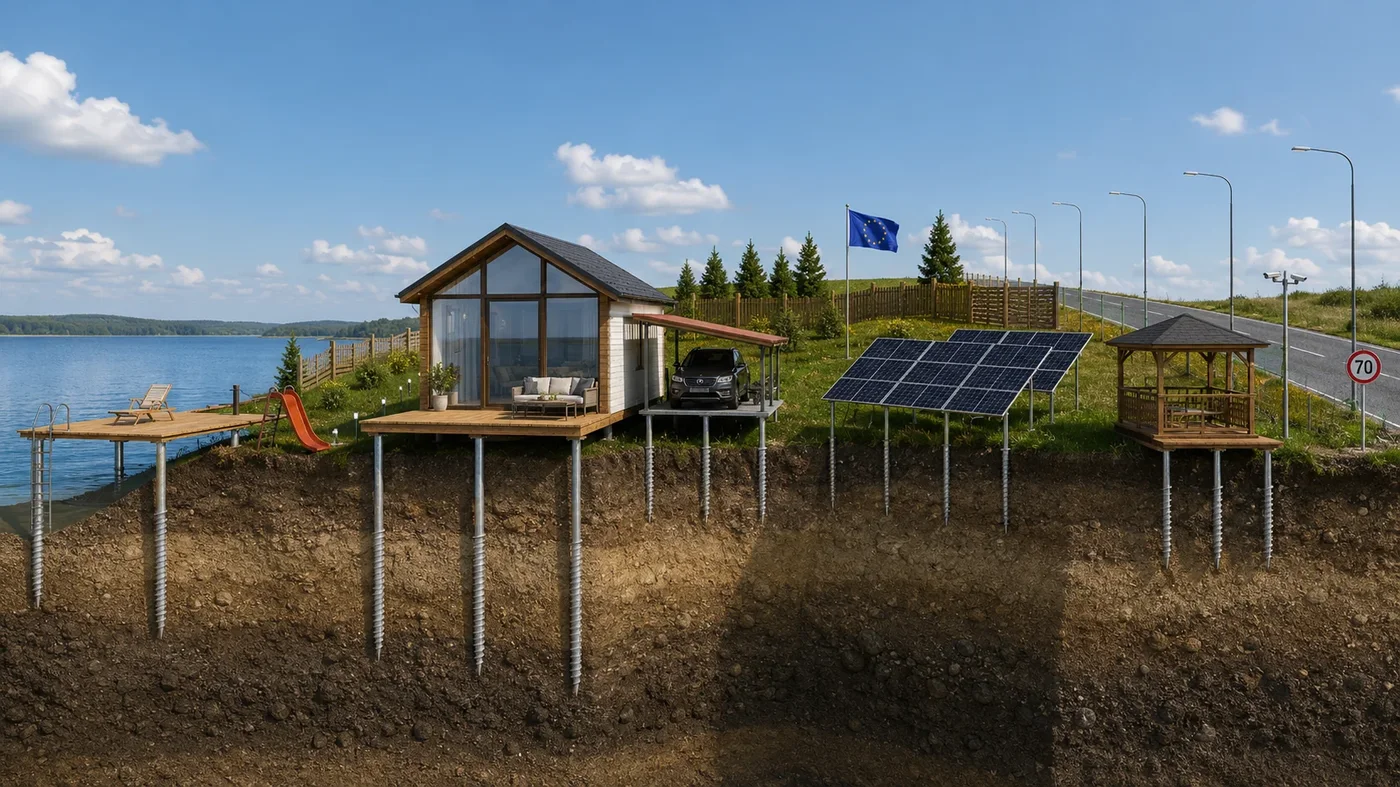
BESS + solar: the same foundation logic, different loads
An energy project can contain on the same site:
That creates an interesting opportunity.
We can analyse steel screw foundations for several categories of equipment, but we do not use the same product for all of them just for simplification.
A panel support and a BESS container have completely different requirements.
So do:
- a transformer
- a lighting pole
- a fence
- a technical room
- a PCS skid.
The advantage is to use the same foundation philosophy, not necessarily the same screw.
How do we approach a MARTETIC BESS project?
General plan, equipment, dimensions, positions and loads.
We are especially interested in:
We start from the real support positions of the equipment.
Depending on the project, one-piece products, modular systems or Custom configurations can enter the analysis.
On a large project, the ground must be verified representatively for the important areas of the site.
Depending on the loads, the following may be relevant:
Products, lengths, number of points and the distribution structure.
With control of position, verticality and levels.
Very important before the prefabricated equipment arrives.
Products, batches, installation and tests, according to the services contracted.
Why is testing so important on soft ground?
Because two values from a table cannot perfectly describe a site of several hectares.
The ground can vary.
At one end we may have a better layer at 2.5 metres.
At the other end it may appear at 4 metres.
In fill areas, the differences can be even greater.
That is why, for important energy projects, we can install test points before series execution.
Then we carry out tests in:
The relevant result is not only:
Can we measure the capacity from the machine's pressure alone?
No.
The hydraulic pressure observed during installation is useful for process control, but it must not be automatically confused with a certified torque value or with a load-bearing capacity.
For BESS and solar projects of significant size, the more robust approach is:
Not just a reading from the machine.
How do we control the settlement of a BESS?
We are not interested only in each screw resisting individually.
We are also interested in how the whole foundation works together.
For example, for a container supported on 12 points:
if all the points move very little and relatively uniformly, the behaviour can be good.
If a single point moves significantly more than the others, the stiffness of the container and the platform can redistribute the loads.
That is why we analyse:
- the reactions
- the stiffness of the distribution structure
- the displacements
- the differences between points
- the tolerances of the equipment.
What happens if the equipment changes during the project?
It is a very possible situation in an energy project.
The project may start with a certain BESS supplier and later another piece of equipment is chosen.
If the following change:
- the mass
- the size
- the support positions
- the centre of gravity
- the lower routes
the foundation must be re-checked.
We do not recommend installing the foundation to the geometry of preliminary equipment and then assuming that any container of similar dimensions will fit.
When is a screw foundation NOT the right solution?
Not every site is suitable.
Situations with the following must be analysed carefully:
- rock very close to the surface
- large boulders distributed across the site
- old foundations
- buried concrete
- fill with massive debris
- dense underground utilities
- a very aggressive chemical environment
- manufacturer requirements for a continuous slab
- lateral loads that cannot be resolved efficiently with the proposed configuration.
In these situations, the following may be more suitable:
concrete, a hybrid solution or another foundation system.
That is not a disadvantage of the technology.
It is simply correct design.
What advantages can the screw foundation have for a BESS developer?
In a suitable project, the advantages can be important:
- fast execution
- no curing time for the steel foundation
- reduced excavation
- reduced quantity of soil removed
- reduced concrete
- adaptation to sloping ground
- the possibility of different lengths
- installation in stages
- direct on-site testing
- precise survey control
- the possibility of dismantling
- reduced intervention on the site.
For modern BESS systems, where the units are delivered with a high degree of prefabrication, the speed of site preparation can matter for the schedule of the whole project.
But the cost?
We cannot say that a screw foundation is always cheaper.
The comparison must be made between complete solutions.
On very good ground and a simple foundation, concrete can be competitive.
On soft ground, the equation can change very quickly.
Especially when the alternative involves excavating or improving a large quantity of ground.
An important advantage for decommissioning
Energy parks are designed for a certain period of operation.
At the end the following may arise:
- equipment replacement
- repowering
- relocation
- decommissioning.
A steel screw foundation can be designed so that many of its elements can be extracted at the end of use.
That can reduce the volume of permanent foundations left in the ground.
The reuse of extracted products must not, however, be assumed automatically; their condition and the new project must be checked separately.
The foundation for BESS must be thought through together with the platform
A good project does not just mean positioning the piles and then filling everything with stone.
The following must be thought through together:
- the equipment foundation
- the drainage
- the levels
- the access
- the cable routes
- the pedestrian platforms
- the vehicle access
- the position of the transformers
- the fencing
- the lighting
- any future extensions.
In many cases we can have:
That way we separate two functions:
the landscaped ground at the surface provides access and drainage, while the structural foundations transmit the equipment loads to depth.
Frequently asked questions
Are foundation screws suitable for BESS?
They can be very suitable when the equipment allows point supports or can be mounted on a distribution structure, and when the geotechnical conditions allow the required capacity to develop.
Can a BESS container be installed directly on four screws?
It should not be assumed. The number and positions of the supports must be determined from the equipment documentation and from calculation.
What do we do if the ground is very soft?
We can analyse crossing the weak layer using longer screws or modular systems down to a more suitable layer. The solution must be verified geotechnically.
Can we use screws of 3–4 metres?
Yes, there are modular solutions that allow greater depths to be reached, but the length is not chosen arbitrarily.
Are tests necessary?
For BESS and major energy projects, on-site testing can be very valuable and can be required by the designer.
What test is carried out?
Depending on the loads, compression and/or uplift tests can be carried out, with measurement of displacements.
Do the screws work if there is water in the ground?
It is possible, but both the geotechnical behaviour and the durability and corrosion must be analysed.
Can concrete be avoided completely?
In certain projects, yes, for the main foundation of the equipment. In others, local concrete elements or a hybrid solution may remain.
Can they also be used for transformers and inverters?
They can be analysed, but each piece of equipment has its own loads, geometry and requirements.
Can I use the same screws for panels and for BESS?
Not automatically. The foundation philosophy can be the same, but the products and configurations must be adapted to each structure.
Conclusion: why a screw foundation makes sense for BESS and solar on soft ground
On a good site, there are several foundation solutions that can work.
On soft ground, the choice becomes more interesting.
Instead of automatically trying to turn the first metres of ground into a rigid structural platform, we can analyse whether it is more efficient to:
For BESS, that can mean steel screw piles + a structural platform adapted to the equipment.
For solar, it can mean hundreds of points installed mechanically and verified for compression, uplift and the loads on the structure.
And for a BESS + PV project we can apply the same foundation logic to several categories of equipment, adapting the product to each use.
A screw foundation is not the right solution for every site.
But where the weak surface ground can be crossed and there is a suitable layer at depth, it is one of the first solutions worth analysing.
Do you have a BESS or solar project?
Send us:
- the site plan
- the geotechnical study
- the type and dimensions of the equipment
- the weights and reactions, if available
- the support positions
- photographs of the site
- the levels
- the project schedule.
MARTETIC can analyse the foundation configuration, the lengths required, the support grid, the connecting structure, mechanised installation and the on-site testing programme.
Send the BESS project for analysis