“Are foundation screws certified?” is one of the questions we receive frequently before quoting.
The answer should not be only:
“Yes, they have CE.”
For a structural product, what matters is which document exists, for which product it is issued, what performance it declares and whether it can be linked to the model and batch that the client actually receives.
The CE marking, the Declaration of Performance – DoP, EN 1090, galvanising to ISO 1461 and the EPD are different documents or benchmarks. They do not certify the same thing and must not be confused with one another.
Yes, foundation screws can be accompanied by the technical and compliance documentation applicable to the product, but there is no single “certificate” that proves everything.
Depending on the product and the project, the documentation can include:
- data sheet
- Declaration of Performance – DoP
- CE marking and information
- identification of the product and batch
- documents on production control
- information on hot-dip galvanising
- traceability declaration
- EPD, if available for the product concerned
- installation and testing documents, when these services are contracted.
The most important thing is that all the documents lead to the same physical product.
Product certification does not replace the design of the foundation.
And a good design does not compensate for using a product without identification and traceability.
What does each document actually prove?
The simplest way is to separate them.
| Document / standard | What it tells us | What it does NOT prove on its own |
|---|---|---|
| CE | the product is declared within the applicable technical framework | that it is suitable for any house and any ground |
| DoP | the performance declared by the manufacturer for the product | the sizing of the foundation |
| EN 1090-1 | conformity assessment of structural components within the applicable scope | the load-bearing capacity in the ground |
| EN 1090-2 | requirements for the execution of steel structures | that the foundation is sized correctly |
| ISO 1461 | requirements for hot-dip galvanising | a fixed lifespan in any ground |
| EPD | data on environmental impact over the life cycle | structural resistance or that the product is “the most ecological” |
So, when a supplier says:
the good question is:
What does the CE marking mean?
The CE marking is probably the best known and, at the same time, one of the most misinterpreted.
For construction products, the CE marking is linked to the declared performance of the product within the applicable technical framework.
It does not mean that a European authority took every single screw, tested it and “approved it for any house”.
For the client, the useful question is not only:
“CE for which product, on the basis of what specification and with what declared performance?”
In the information associated with the product, the following should be traceable, as applicable:
- the manufacturer
- the product type code
- the Declaration of Performance
- the applicable standard or technical basis
- the intended use
- the declared performance
- the notified body, when the system involves one
- the identification needed for traceability.
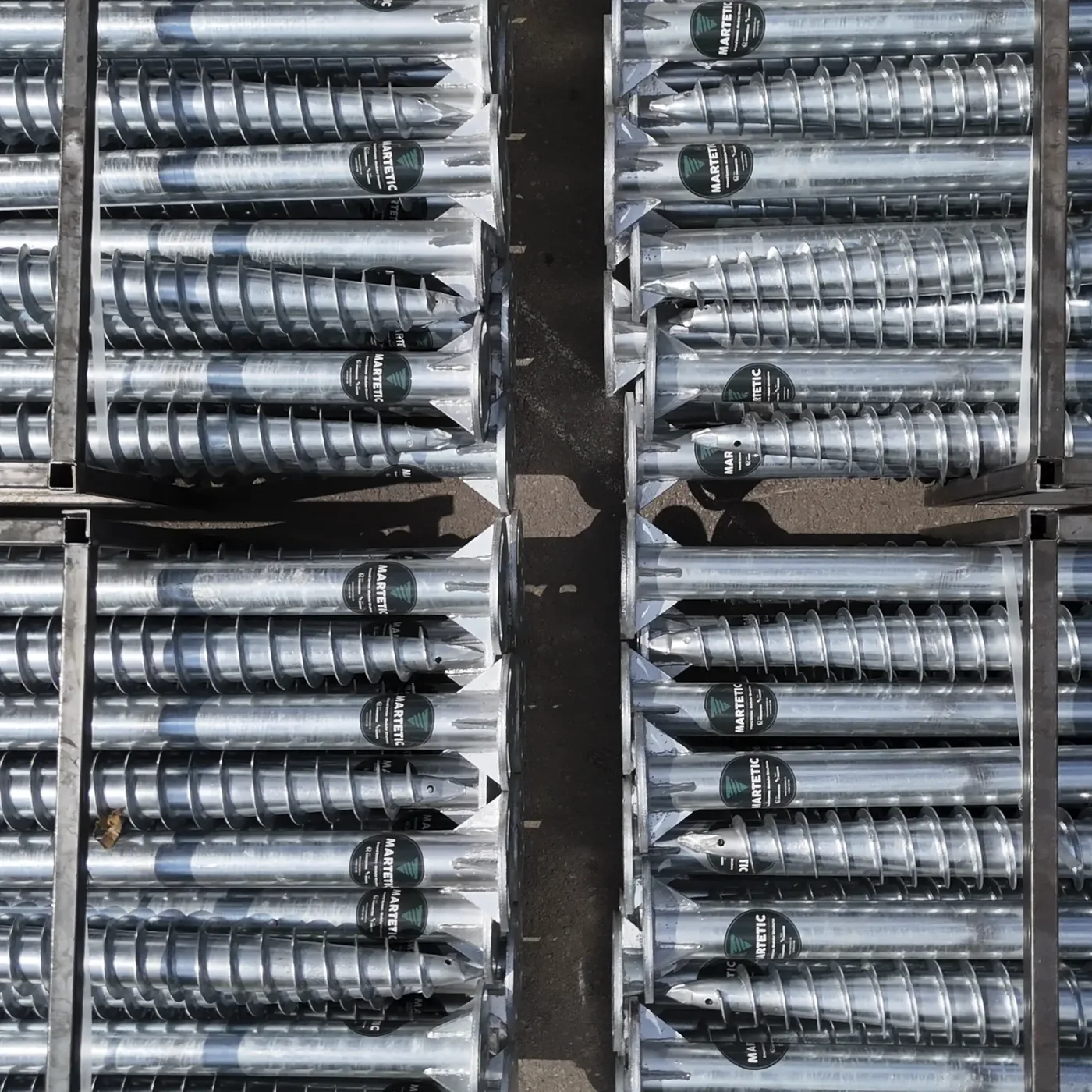
In practice, for screws delivered on pallets, the pallet label and the batch identification are very important.
They link the products you see on site to the documents you receive.
Does CE mean the screw can support any house?
No.
This is probably the most important clarification in the article.
A product with CE marking does not automatically become suitable for:
- any house
- any container
- any number of storeys
- any load
- any ground
- any spacing between points.
The marking and the product documents give the designer the information needed to be able to analyse the product.
Then it must be checked whether that product is suitable for the specific building and site.
It is exactly the same logic that we use in all the MARTETIC guides:
What is the Declaration of Performance – DoP?
DoP comes from Declaration of Performance.
It is one of the central documents for construction products within the framework where it applies.
Through the DoP, the manufacturer declares the relevant performance of the product type for its intended use.
In a DoP we mainly check:
- the number of the declaration
- the product type code
- the intended use
- the manufacturer
- the applicable assessment system
- the relevant standard or technical document
- the notified body, where applicable
- the declared performance
- the manufacturer's assumption of responsibility for the document.
A DoP is not the same as the data sheet
The data sheet usually describes the product:
- dimensions
- materials
- geometry
- options
- applications
- technical characteristics.
The DoP has a different function: it is the formal declaration of the product's performance within the applicable framework.
Both documents are useful.
But they are not interchangeable.
Can one DoP be used for all screw sizes?
Not automatically.
A document for a certain product type cannot be extended by assumption to:
- another diameter
- another thickness
- another length
- another thread
- another flange
- another geometry
- other extensions.
A family can include several variants only if they fall within the limits of the technical documentation on which the declaration is based.
That is why it is important that the product in the offer, the product on the pallet and the product in the DoP can be clearly correlated.
What does EN 1090 mean?
EN 1090 appears very often in the documentation of steel products.
But here too a distinction must be made.
It relates to the conformity assessment of structural steel and aluminium components placed on the market, within the standard's scope.
The fact that a factory has a system certified to EN 1090-1 is important.
But it does not mean:
It must be checked whether the specific product falls within the scope of that documentation.
EN 1090-2 concerns the execution of steel structures.
The standard deals with aspects such as:
- materials
- preparation of parts
- welding
- mechanical joints
- tolerances
- surface treatment
- inspections
- execution control.
The documentation may also state the execution class, for example EXC2.
This shows the level of control applicable to the steel execution.
The capacity of the foundation on site is a separate matter, which depends on the product, the ground, the depth and the project's loads.
What does AVCP 2+ mean?
AVCP is the system of Assessment and Verification of Constancy of Performance.
In system 2+, the manufacturer organises Factory Production Control – FPC, and a notified body certifies and supervises this control within the limits of the applicable system.
Production control can include:
- receipt and identification of raw materials
- process control
- equipment control
- welding procedures
- qualification of personnel
- inspections
- management of non-conforming products
- manufacturing records.
It is very important.
But the notified body does not design the house and does not check every screw installed on a site in Romania.
The roles are different.
Is it enough to receive the factory's EN 1090 certificate?
No.
The factory certificate is one piece of the file, not the whole file.
If you only receive a photograph of an EN 1090 certificate, you should be able to ask for the documents of the specific product as well.
For verification, the following are important:
- the product
- the data sheet
- the DoP
- the CE information
- the batch
- the scope of the certificate
- the traceability.
A factory certificate with no link to the delivered product is not enough on its own to prove what you have bought.
What does ISO 1461 mean?
ISO 1461 relates to the hot-dip galvanising of products made of iron and steel.
The standard sets requirements and verification methods for the coating.
Aspects that can be monitored include:
- the thickness of the layer
- continuity
- uncoated areas
- preparation of the part
- the geometry
- repairs
- checking the layer.
For a foundation screw, galvanising is very important because the product works in contact with the ground and moisture.
But:
ISO 1461 is not a universal guarantee of 50 or 100 years.
Durability depends on the real environment, the steel thickness, the protection, water, pH, salts and other conditions.
We explained the issue in detail in the article:
How long do foundation screws last?What does EPD mean?
EPD stands for Environmental Product Declaration.
It is a completely different document from CE or the DoP.
An EPD provides quantitative information on environmental impact, calculated through a life-cycle analysis within the declared boundaries.
It can contain information about:
- global warming potential
- resource use
- energy
- waste
- production
- transport
- installation
- end of life
- recycling or other modules included in the declaration.
An EPD is very useful for designing buildings where environmental impact is analysed.
But an EPD does not automatically mean “ecological product”, nor does it prove that the foundation concerned is structurally better.
It is a transparency and environmental assessment document.
Does the EPD prove that a screw foundation is more ecological than concrete?
Not on its own.
To compare two solutions we must compare the same function and the same boundaries.
For example, it is not correct to compare:
and declare one of the foundations the winner.
Two solutions capable of supporting the same building, in the same conditions, must be compared, taking into account the real quantities and the life cycle.
The EPD provides data for this calculation.
It does not replace the calculation.
What does traceability mean?
Traceability is one of the most important parts of a serious documentation system.
It means that we can follow the product:
In practice, a traceability system can use:
- the product code
- the production batch
- the pallet
- the label
- the delivery note
- the invoice
- the installation acceptance report.
It is not mandatory for every screw to have a separate file of dozens of pages.
What matters is that there is a clear chain.
If in a few years we need to know what product was installed, the documents must allow it to be identified.
Why does the exact product name matter so much?
Because seemingly small differences can matter.
For example:
are not the same technical specification just because the diameter and length are identical.
The documents must reflect the product actually delivered.
If a management system uses a simplified commercial name, this must not create contradictions in the technical documents sent to the client.
This is one of the basic rules of MARTETIC traceability:
What documents should the client receive?
It depends on whether MARTETIC delivers only the products or also carries out the foundation.
Depending on the product and the applicable framework, the package can include:
- the data sheet
- DoP
- the CE marking information
- batch identification
- traceability
- the additional documents applicable to the product.
In addition to the product documents, the following can be included:
- the plan or identification of the points
- the installation acceptance report
- the quantities actually installed
- the models and lengths
- any deviations
- acceptance documents
- the test report, if testing was contracted.
This is something we want to make very clear:
Do CE or the DoP prove that installation was done correctly?
No.
A screw can be perfectly documented and still be installed wrongly.
For example:
- wrong position
- wrong level
- unacceptable verticality
- an improvised connection
- changing the product on site
- damage to the product.
That is why the product documentation must be complemented, when MARTETIC carries out the work, by documentation of the installation.
In the article:
How are foundation screws installed?we explained the execution and verification process separately.
How do you check the documents in 10 minutes?
You don't have to be a specialist in standards to notice the obvious problems.
You can do the following check:
compare the product name in the offer with the one on the invoice
compare the product with the data sheet
check the diameter, length and thickness
look for the product code and the DoP number
check whether the DoP refers to that product
check the standard and the declared use
check the identification of the manufacturer
check the batch on the pallet or in the delivery documents
check that documents on galvanising exist
if there is an EPD, check the product or family covered by the document.
If one document says M76, another M89 and the physical product cannot be identified clearly, we have a problem.
Which claims should be viewed with caution?
What document, for which product, and under which standard?
What performance is declared and how was the foundation sized?
Is the specific product covered by the applicable documentation?
What protection does it have and in what environment will it be used?
What indicators are declared and what complete solution is it compared with?
Documents are very important.
But they must be read for what they actually demonstrate.
Certificate, test report, data sheet or declaration?
These are not the same thing either.
It is issued, depending on the system, by a competent body and confirms what falls within the scope of the certificate.
It shows the results of a test carried out on a product or sample, under certain conditions.
It describes the product and its characteristics.
It is the manufacturer's declaration of the product's performance within the applicable framework.
It documents the process or batch and, where available, the measured values.
No document should be used to claim more than it demonstrates.
But what about capacity tests?
A test report is very valuable.
But it must be read with the same precautions.
If a certain screw was tested at a certain site and obtained a certain result, that does not automatically mean:
The test says something about:
- the product tested
- the configuration tested
- that depth
- that ground
- the test method
- the conditions of that test.
That is why test results and CE/DoP documents have different functions and complement each other.
What documents exist behind the manufacture of a product?
The client does not always receive the factory's whole internal file.
But behind a structural product there can be documents such as:
- material certificates
- identification of heats
- fabrication drawings
- welding procedures
- WPS
- qualifications for welding procedures
- welder qualification
- dimensional inspections
- weld inspection
- galvanising documents
- records of non-conforming products.
These elements are part of the manufacturing control system.
They do not, however, replace the DoP, the CE marking or the design of the foundation.
Who is responsible for the documentation?
There are several roles and it is good for them to be separated.
Defines the product, prepares the technical documentation and the applicable declarations, and maintains production control.
When the manufacturer is outside the European Union, it has obligations to verify and keep the documents within the applicable framework.
Must keep the identification of the product and pass on the necessary documentation.
Checks whether the product is suitable for the structure and the site of the project.
Carries out the foundation according to the work documents and records deviations and changes.
Must keep the documentation and provide the real information about the project and site.
In MARTETIC's case, when we act both as distributor and as installer, the documents must be kept separately and coherently:
What does a coherent file for a MARTETIC job look like?
Let's take a simple example.
The project provides for 24 M89 × 2,000 mm screws.
On delivery, we should be able to trace:
24 pieces with the ordered geometry.
model, quantity, batch and manufacturer.
diameter, length, thickness, thread, flange and corresponding materials.
correlated with the product type.
within the applicable limits and the contract.
documented according to the product's requirements.
24 defined positions.
the products and batches are linked to the work carried out.
If at acceptance an important difference appears, for example another length, another thickness or another flange, the product must not be installed automatically just because the team is already on site.
First the difference is clarified.
How does MARTETIC communicate documentation?
We prefer precise wording.
Not:
“All our screws are certified for houses.”
But:
“The products are accompanied by the applicable documentation, and the foundation configuration for a house is determined through the design.”
Not:
“CE guarantees 50 years.”
But:
“The CE marking is linked to the declared performance; durability is verified according to the product, the protection and the environment of use.”
Not:
“An EPD means we are automatically the most ecological foundation.”
But:
“An EPD provides environmental data that can be used to assess the building's life cycle.”
Not:
“EN 1090 guarantees the capacity of the foundation.”
But:
“EN 1090 concerns the assessment and execution of structural components; the foundation is verified separately for the project and the site.”
Frequently asked questions
Are MARTETIC foundation screws certified?
Depending on the product and the applicable scope, MARTETIC products can be delivered with the relevant technical documentation: data sheet, DoP, CE information, traceability, the applicable manufacturing and galvanising documentation, and an EPD where the document covers the product or the family concerned. The exact documentation must be checked for the model ordered.
If it has CE marking, can I put the screw under any house?
No. The product must be selected and sized for the building, the loads and the ground.
Is the factory's EN 1090 certificate enough?
Not on its own. It must be correlated with the specific product, the DoP, the data sheet, the label and the batch.
Is the DoP the same as the data sheet?
No. The data sheet describes the product. The DoP declares the product's performance within the applicable scope.
Does ISO 1461 mean the screw does not rust?
No. Hot-dip galvanising provides corrosion protection, but the lifespan depends on the product and the environment in which it is installed.
Is an EPD a structural certification?
No. An EPD concerns environmental impact, not load-bearing capacity.
Can I receive a single DoP for several identical screws?
A document may apply to a batch or a delivery of products of the same type, as long as the products are identified and the document applies to them.
Do I also have to receive the installation documents?
If installation is part of the contracted service, the execution documentation must be set out in the offer and the contract. It is separate from the product documents.
Who issues the DoP?
The DoP is issued and assumed by the manufacturer for the type of product covered by the declaration.
Is CE marking an “approval”?
It is not correct to automatically use the terms as synonyms. CE marking and the Declaration of Performance operate within the European framework for construction products and must be read in relation to the product and its declared use.
What should you ask for before buying foundation screws?
For a structural foundation, ask for at least:
- the exact product name
- the diameter
- the length
- the thickness
- the data sheet
- the applicable CE/DoP documentation
- information about manufacturing
- the galvanising documentation
- the batch identification
- the traceability
- the documents you will receive after installation
- the test report, if testing is part of the project.
Don't buy a foundation based only on the claim:
A foundation is a structural element.
The documents must be verifiable.
Conclusion: what does a correctly documented foundation screw actually mean?
It does not mean having a PDF with the CE logo in a folder.
It means being able to trace clearly:
A good technical file is coherent.
The product name, code, dimensions, batch, data sheet, DoP and CE information must lead to the same product.
ISO 1461 documents the galvanising part, and the EPD adds the information on environmental impact.
But none of these documents replaces the correct design and installation of the foundation.
At MARTETIC we want the client to know not only that documents exist, but also what they mean and what they don't mean.
Do you have a project and need the foundation documentation?
Send us the building plan, the locality, the geotechnical study if there is one and the designer's requirements.
We can identify the products, the related documentation, the installation and the checks the project needs.
Send the project for analysis